

Stir-frying is a Chinese cooking technique that uses very high heat to quickly sear meats and vegetables. The term, “stir-fry” is misleading. The true technique is really about rapidly flipping and turning the ingredients for even cooking, not merely stirring them.

In a Cantonese restaurant in Hong Kong, you will find the chefs using stoves that are more like volcanoes, putting out 200,000 BTUs of heat. They have to work so fast, the ingredients are constantly moving and flipping in the wok. This takes special training, and a lot of forearm strength. Student chefs at New Oriental practice with sand in old, worn out woks, using a large spatula that looks like a shovel to push the sand to the far side of the wok while simultaneously pushing downward on the near handle to cause the whole pile to turn over. Why do they use sand? Because the weight builds strength, and the technique takes lots of practice in order to keep the sand (and later actual ingredients) in the wok instead of flying all over the stove top.
Stir-frying at home
The typical home stove does not come anywhere close to the heat produced by a stove in a professional restaurant. This is actually a good thing. Not only do you not have to master the techniques of professionals, but you won’t incinerate your ingredients into little chunks of charcoal. A home range might reach 12,000 to 14,000 BTUs. Despite the heat differential from a professional stove, you can successfully stir-fry at home. The basic principles are the same.
The best woks for this type of cooking are carbon-steel. You can also use a good, old-fashioned cast-iron skillet, which can handle high heat and, when properly seasoned, is non-stick. In fact, I use a 10-inch flat-bottom Lodge cast iron skillet, with 2 inch deep sides.
If you have a gas range, a flat-bottomed 14-inch carbon steel wok with a wood handle on one side is your best option. If you opt for a cast-iron wok, the Chinese make a cast-iron wok that is thinner and lighter than the typical American cast-iron. You can use a traditional round bottom wok if you have a wok ring that sits around your burner to stabilize the wok.
Comparing carbon-steel woks and cast-iron skillets
The advantages of thinner carbon-steel woks, or a cast-iron skillet, are that they heat quickly, and evenly, and cool rapidly when removed from the heat. This is important in controlling the heat of your cooking.
However, a wok has two key advantages over a flat-bottom skillet: the flat bottom skillet requires more oil than the wok, so care must be taken with the skillet to keep it non-stick by proper seasoning to avoid oily, greasy food; the sides of the wok and its shape make it easier to turn and flip ingredients and the sides have some heat, aiding your cooking. With the cast-iron skillet, you cannot use the sides to your advantage, other than having deep sides to keep food in the pan when turning quickly.
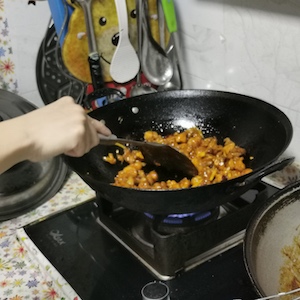
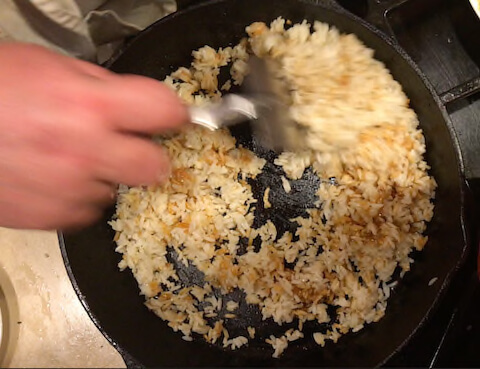
I find that with a cast-iron skillet, a short-handled flat spatula is best. Longer handled spatulas make is harder to keep the ingredients in the pan when turning quickly. However, with the wok, a longer handled spatula with a blade contoured to the wok allows you to work all of the ingredients at once.

Common tips for both carbon-steel woks and cast-iron skillets
- Have all your ingredients prepared before starting to cook. The longest time required is preparation for most dishes. The actually cooking for a stir-fry is done in mere minutes.
- Cut all ingredients to a consistent thickness and shape. This is not only aesthetically pleasing, but it ensures that the ingredients cook evenly.
- Unless browning meat, like pork belly, over medium-low temperature, heat the wok or skillet to the point that a droplet of water will sizzle and burn off in 1 to 2 seconds. The wok does not have to be white hot. In fact, you will get better results if you keep the temperature such that you hear a sizzling sound as you cook.
- When the pan is hot, swirl some oil in the pan to coat the surface, and pour off into a heat-proof container.
- For firm vegetables that take a long time to cook, such as broccoli and carrots, blanch them ahead of time. Use boiling water for a minute, then remove the vegetables and place them in ice water to stop the cooking. Drain them and dry them completely. The goal is not to make the soft. Good stir-fry vegetables should be crispy.
- If you are cooking meat, let it warm to room temperature. Cold meat will cool the wok, increase the cooking time, and make the meat dried out and tough instead of seared, tender, and juicy. If you are using a marinade to flavor the meat, let it sit in the marinade on a counter to warm to room temperature before cooking.
- If you have more than 6 to 8 ounces (225 grams) of meat, cook the meat in batches.
- Add the seasoning ingredients, such as garlic, ginger, and chili peppers, to the oil, then add the meat. Let it brown on one side for 30 seconds, then turn it. This sears the meat, keeping it moist inside.
- When the meat is browned, remove it, bring the wok back to temperature, and cook the next batch of meat. Repeat until all the meat is browned.
- Reheat the wok, add fresh oil and cook vegetables like onion, peppers, celery first. When these are giving off an aroma, add green leafy vegetables, shredded cabbage, etc. as these cook very quickly.
- When the vegetables are done, add the browned meat back into the pan and stir to combine the flavors.
Non-stick woks
Non-stick woks are usually coated with teflon. Do not use a non-stick pan if you can avoid it. The teflon coating is toxic.
Do not heat an empty non-stick pan to high temperature. Instead, add the oil to the pan, then heat the pan. Further, the coating is toxic. Over time, the coating will flake and break down, and this adds toxic compounds to the food.
Learn from the experts
For more information about wok cooking, consult the following resources:
https://consults.blogs.nytimes.com/2010/09/17/expert-tips-from-the-stir-fry-chef/
https://www.graceyoung.com/cookbooks/cookbook-3/
https://www.thespruceeats.com/tips-for-perfect-stir-fry-995435
Do you enjoy My Chinese Home Kitchen?
We enjoy sharing these authentic home recipes with you. To learn more about My Chinese Home Kitchen, please visit our About page.
Please leave a comment, or SUBSCRIBE to our newsletter.
For more of our original videos, visit My Chinese Home Kitchen on YouTube and Rumble.

