One of the challenges I face in learning to cook Jing’s delicious recipes is finding authentic ingredients. Since she is in China and I am in the Texas Hill Country, I have never tasted her recipes as cooked by her. So this makes finding suitable substitutes for some ingredients to be quite a challenge. I spend a lot of time researching sources for ingredients. In the process, I have learned there are over 1,200 kinds of Chinese noodles. These fall into a few main types: wheat noodles, alkaline wheat noodles, egg noodles, rice noodles, and mung bean noodles (aka glass noodles, cellophane noodles, Chinese vermicelli, or bean threads).
Image credit: Glenn Emerson for My Chinese Home Kitchen, 2023
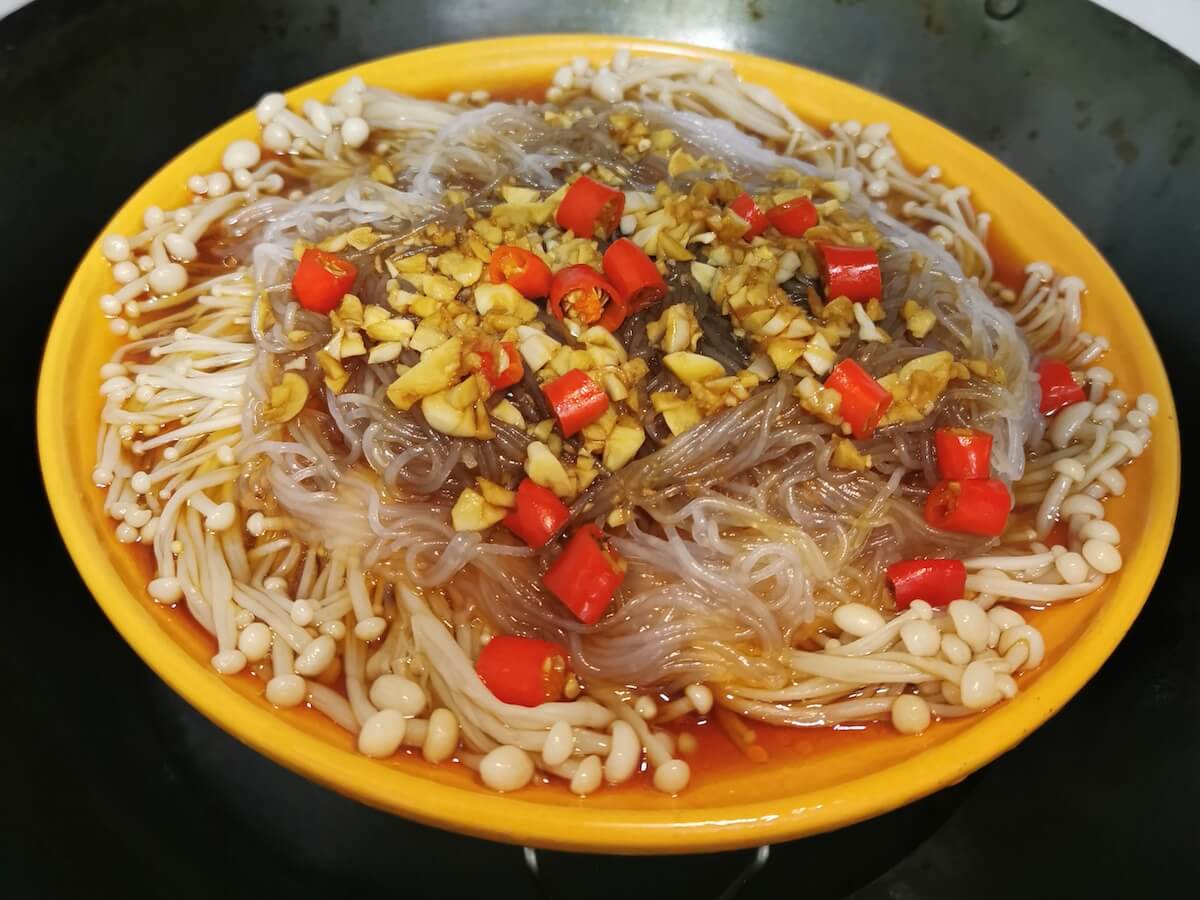
Today’s Garlic and Enoki Mushroom with Vermicelli recipe is popular with garlic lovers! We use garlic, enoki mushrooms, and mung bean vermicelli (also called cellophane noodles or bean threads) as ingredients. This is an easy recipe to make with simple steps. It can be served as a side dish with lunch or dinner, or as a main course. If you don’t want your lunch to be rice and some dishes, you can cook this Garlic and Enoki Mushroom with Vermicelli on its own. It’s a good option when you’re eating lunch at home alone.
Alkaline noodles have a different texture from normal wheat noodles (such as Italian pasta). They have more body, or bounce, and a slightly firmer texture. Though both are made from wheat, they are not interchangeable.
Homemade Fried Noodles
Fried noodles are a traditional snack popular in both northern and southern China. Whether in the bustling streets or in formal restaurants, you will find pan-fried noodles. People use a wide variety of ingredients to cook a wide variety of fried noodles recipes. Most Chinese family lunches are a meal of rice and some stir-fry, but, if you don't want to cook rice and stir-fry at home, it's a good choice to make fried noodles. NOTE: Chinese broccoli or spinach leaves make a delicious choice for the leafy greens. For the protein, try diced Kou Rou, diced bacon, or diced ham for delicious alternatives. For a bit of spice, chop up a dried er jing tao pepper and add it with the garlic and red onion.
I have substituted both mung bean vermicelli and rice vermicelli in the Homemade Fried Noodles, with good results. Feel free to experiment.
Mung bean vermicelli. Image credit: Glenn Emerson for My Chinese Home Kitchen, 2022
Cold Noodles with Summer Vegetables
Do you want to eat a bowl of warm noodles on a hot summer day? The answer is, of course, no. But what should you do when you really want to eat noodles? So, today we will make a northern Chinese cold noodle dish called Liáng miàn that can be eaten in summer.
Jing’s Braised Noodles with Beans is best made with round Chinese alkaline wheat noodles, such as those used in Dan Dan Mian. Called jian shui (枧水) Wenzhou mian (literally, alkaline water noodles made in Wenzhou), these dried noodles need to be simmered a bit longer than the fresh Chinese noodles called for in Jing’s recipe. These noodles are thicker than Ramen noodles, and also work well in the Cold Noodles with Summer Vegetables recipe.
Jianshui Wenzhou Mian Image credit: Glenn Emerson for My Chinese Home Kitchen, 2022
Braised Noodles with Beans
Braised noodles with beans is a traditional specialty food in northern China, but it is relatively rare in southern China. When braising noodles we use steam to simmer the noodles. The noodles are spread over the beans and pork in the broth, and the hot steam soaks into the noodles while the beans and pork are braised by the liquid. When we make this dish, we use raw alkali noodles for cooking, because the alkali noodles can not only absorb the flavor of the soup better during cooking, but also ensure it is al dente. Raw noodles are used because cooked noodles will absorb more water after being cooked for a long time, which causes the noodles to become too soft, degrading the texture of the noodles.
My Chinese Home Kitchen does not accept paid endorsements of products or participate in affiliate marketing. Products or brands listed are those we actually use ourselves. Opinions about those products are entirely our own, free of commercial influence. We are also ad-free. All of our support comes from private sources and the generous contributions of readers like you.
Search
Chen Jing
I was born in Guangxi. As long as I remember, I have liked cooking.
When I was a child, my dream was to become a gourmet and travel the world to taste the food of various countries. My ambition is to become a chef. The kitchen is my partner. There are many kinds of Chinese cuisine, there are 8 kinds, reflecting the richness and diversity of Chinese geography and history. I am very happy to share with you Chinese cuisine and cultural traditions.