

I always had the impression that Chinese cuisine was all stir-fried in a wok. I’ve learned a lot from Jing about real home-cooked Chinese food, and I have began to rethink my diet and cooking techniques as a result. Steam cooking is essential to healthy eating. What’s more, it’s an easy way to make a delicious hot lunch while working from home, without standing over a stove.


A bit of history
The wok is one of the most useful and flexible cooking pots ever designed. You can do anything with a wok, from stir-frying to braising to simmering to deep-frying. You can even steam foods with a wok and a steam rack, or a stack-able set of bamboo steamer trays. Archaeology shows that the Chinese were cooking with steam as far back as the neolithic era, many millennia ago. Even though every home has a wok, steam cooking is still essential.
The wok appears to be a rather recent acquisition as Chinese kitchen furniture goes; it has been around for only two thousand years….
The oldest Chinese cooking vessel, still used most, is a deeper, covered pot. In this one boils and steams–still the primary cooking methods in China (stir-frying is a long third) and the only regularly used methods before the days of the wok….
Chinese cooking is primarily boiling and steaming, with stir-frying as a minor but universal adjunct. Restaurants stir-fry more than do private homes; in old days oil was expensive, and stir-frying was practiced sparingly.
Anderson, E. N., 1988. The Food of China, pp. 185-188. Yale University Press
The role of steam cooking in healthy eating
Chinese cooking evolved from scarcity, both of food sources and energy sources. Chinese cooking methods make maximum yield from scarce or expensive ingredients such as meat and fish. However, scarcity of fuel also played a role in cooking techniques. Everything from the design of the stove to the vessels used to cook is designed to get the most efficiency from available fuel sources. Steamed foods fit nicely in this category. A few vegetables, some meat, and rice, can all be prepared in a single cooking vessel, preserving vitamins, minerals, and cooking fuel.
The Chinese prefer lightly cooked foods, with crisp vegetables and flavorful meat and seafood. All of our cooking techniques and recipes on My Chinese Home Kitchen reflect this. Food should not be mushy (unless you are making a porridge) or cooked to the point of losing flavor. Steam cooking is a way of using minimal energy (fuel) to self-baste and sear food to retain its flavor.
Steaming is the most delicate and least demanding of all Chinese techniques….A self-basting method, steaming preserves the natural flavors when the ingredients are unseasoned and intensifies the tastes when the ingredients are seasoned….By the same token, leftovers and pre-cooked foods can be reheated by steaming, which preserves the flavor and texture of freshly cured meats, and rejuvenates dried meats and vegetables.
Kuo, Irene, 1977. The Key to Chinese Cooking, p. 102. Knopf
There are many sources that claim that steamed vegetables, in particular, are healthier than boiled or fried vegetables. Boiling vegetables leach the nutrients out of the food, whereas steam surrounds the food and sears in the nutrients. Frying adds fat and calories.
Steamed vegetables taste better. Carrots and peas are sweet. Potatoes are delicious. Cabbage is sweet and crispy. Broccoli has a bright green color and crispy texture packed with flavor. Hot moisture brings out the flavor in mushrooms. I find I eat more vegetables when they taste good. For me, it’s a simple lifestyle hack.
The role of convenience in healthy eating
For me, the healthy aspect of steaming food comes down to one key fact. I’m busy. I work from home. Taking time out to cook a lunch is not always possible. However, I can dice a potato or two, cut a carrot or two, arrange them in my bamboo steamer on a cabbage leaf or two, and let it steam for 20 minutes. If I want some meat with my meal, I can take some cooked leftovers and put them in the top tray. I set a timer, go back to my work, and in 15-20 minutes my hot lunch is ready.


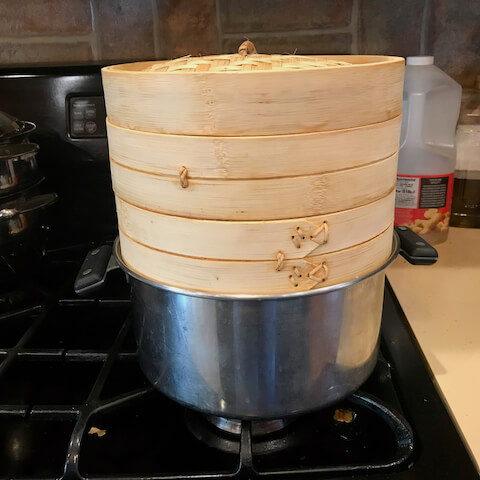
To save the seasoning in my wok, I use a 6-quart saucepan: the 12-inch bamboo steamer rack fits snugly in the rim of the saucepan. I set the water to boil while I peel and wash the vegetables. When the water reaches a rolling boil, the trays get stacked on top of the saucepan (or wok if you prefer to use only Chinese utensils).
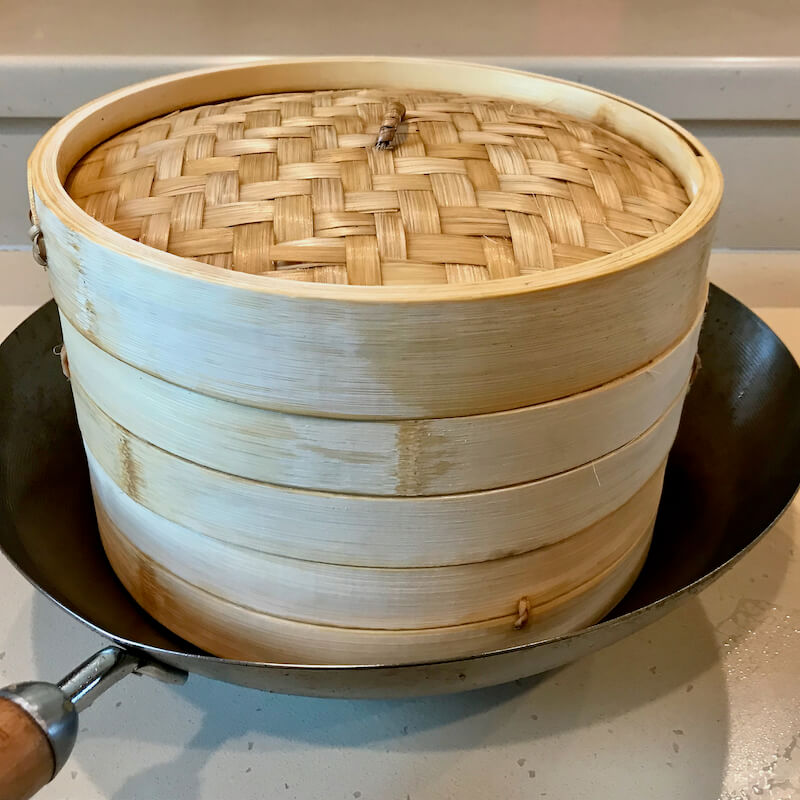

I set the timer for 15 minutes. Then I check the vegetables with a fork to see if they are tender.

Guidelines for successful steaming
Irene Kuo (Kuo, pp 102-103) offers these guidelines for steaming food:
- The water should be boiling before the food is placed in the pot, so that it is “seared” immediately with high heat.
- The food should be well suspended above the boiling water so that the water does not bubble over it.
- The steaming pot should be large enough to contain enough water and provide enough space for the intense steam to circulate around the food.
What about a microwave oven and modern steamer-bagged foods?
Well, yeah, you can use a microwave for some foods, but generally, microwave ovens dry out foods, especially meats. Compare a piece of barbecued chicken reheated in a microwave with a piece reheated with a steamer, and you’ll see the difference. Besides, with a set of bamboo steam trays, which are far cheaper than a microwave, you can prepare a meal for a family all at once, unlike cooking each item in turn in the microwave.
When steaming vegetables in a steamer tray, the only waste is the vegetable peels, and they go in my compost pile, whereas the plastic bags used in the microwave go to the landfill.
Finally, a microwave is not very useful in a power outage, but with a gas stove, camp stove, or barbecue grill you can steam a hot meal. In my lifetime, that’s happened twice. In 1991 we had a devastating ice storm in Western New York state that knocked out power for two weeks, forcing me to leave my apartment. In 2021 we had week-long power outages all over Texas when a cold weather spell knocked out the windmills and natural gas power plants.
Some of the steam-cooked recipes on My Chinese Home Kitchen
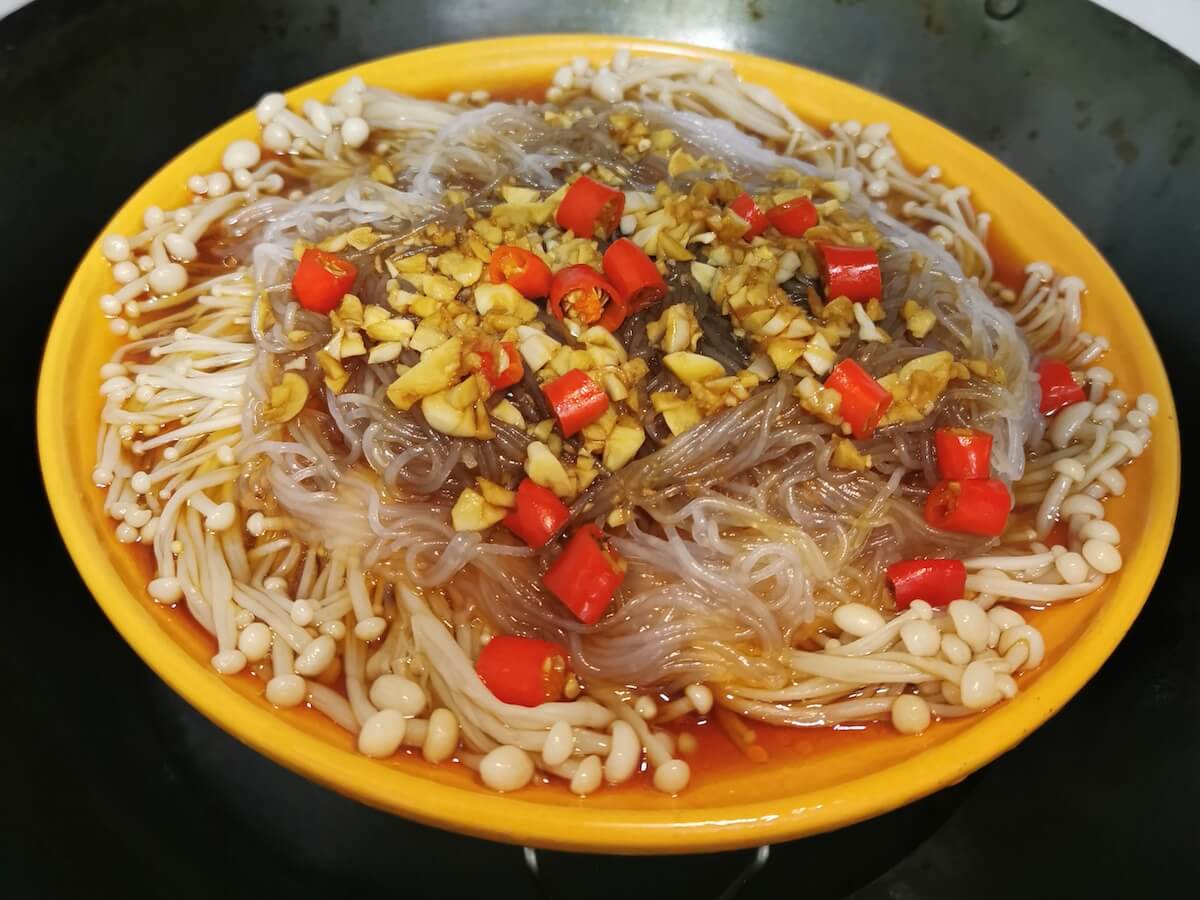


Recipes that use a combination of pan- or stir-frying with steam cooking


Summary: Why is steaming food a key to healthy eating?
Healthy eating requires more vegetables in the diet. When I was a kid, we always had vegetables at every meal. Vegetables, especially home grown or truly organic, are a good source of essential vitamins, minerals, dietary fiber, complex carbohydrates, and in some cases, protein. When I go to the grocery, I tend to limit my shopping to the fresh fruits and vegetables, fresh seafood and meat, and when necessary, the frozen seafood sections.
Lots of microwavable food and other “instant food” are full of empty carbohydrates, emulsifiers, high fructose corn syrup, sugar, and seed oils, so I skip those aisles. There is a growing body of research that links these “processed” foods to the rise in obesity, diabetes, and inflammation-related disorders afflicting Americans. All I know is in the 1970s, everyone was a lot skinnier and diabetes was rare.
Steam cooking and healthy eating is not just about vegetables, however. Nowadays, I preserve some of my own meat. For instance, I make my owned corned beef brisket and jerky from good, farm-raised sources. The Chinese especially use steaming for cooking fish. These foods are also best when cooked or reheated with steam.
Do you enjoy My Chinese Home Kitchen?
We enjoy sharing these authentic home recipes with you. My Chinese Home Kitchen is a labor of love.
Please tell your friends about us!
Learn more about My Chinese Home Kitchen at our About page.
Please leave a comment, or SUBSCRIBE to our newsletter.
For more of our original videos, visit My Chinese Home Kitchen on YouTube and Rumble.


Excellent article on steaming! Steaming isn’t that overwhelming after all, and I like the part about quick chopping , then simply steaming