

Hey dear readers, today we’re talking about something meaningful: rice farming in China. The inspiration for this article came from an email Glenn wrote to me. He mentioned in the email, “As the food shortage worsens, I want to start growing my own Chinese vegetables and my own garden. I want to raise my own chickens… Now with the rapid development of technology, most people’s minds are full of computer technology. They have lost this primitive but useful planting knowledge.”
Glenn’s words reminded me of my childhood. I spent my entire childhood in a rural village in Guangxi, in southern China. Since my father died when I was very young, my childhood planting memories are all of my mom and my uncles. Because there are some jobs that require the strength of a man to do, my mom chose to work with my uncle’s family to complete the planting work.
In the southern part of China, most farmers are rice planters. After the rice is mature, it is hulled to get the rice kernel. This is the staple food of southerners. We cook rice as the staple food every day. This is also one of the very important grains in China.
From sowing to harvesting, the process is full of hard, sweaty work. Because I lived in the countryside, I was involved in the whole process of growing rice.
Selecting the seed
Usually, rice is planted and harvested twice a year. The first planting is harvested after maturity, and after a period of time, preparation for the second planting is started. The first planting rice in the south is generally sown in March-April and harvested in July.
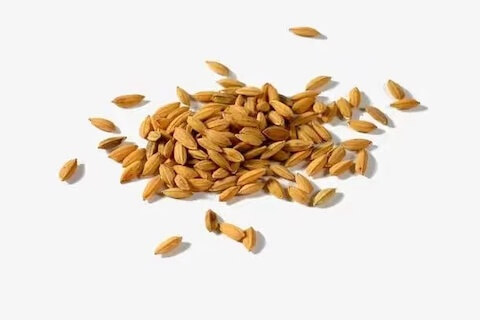
Planting rice is a very complicated matter. First of all, we start with the selection of seeds. In fact, there are many varieties of rice, and the maturing time of different varieties varies. We need to pick seeds that are full of grains and remove any that have borers, mold, or broken seeds. After we have selected the seeds, we need to soak them with water and special germination-promoting liquid. Then the rice seeds are washed.
Nurturing the seeds into seedlings
Then we need to choose a piece of farmland with good terrain as a base for cultivating seeds. This farmland must be convenient for water inflow and drainage.

We need to lay a special mold for cultivating seeds in the wet soil. Then we spread the seeds evenly in the mold. Next, we stir the fertilizer and wet soil evenly. Then we cover the mold, and sprinkle a layer of grass ash on the mold. Finally, we use bamboo strips to make hoops over the rice bed, and cover the hoops with plastic film. This is a thermal shed, as the seeds need to be in a warm environment to germinate. During this period, we need to pay attention to keeping the farmland moist. When the height of the seeds after germination reaches about 8cm, we can remove the plastic hoop tunnels.

Planting the seedlings
Next, we need to dredge the nearby river to prepare other fields to receive the seedlings, so that the dry soil becomes moist. When the soil is wet enough, we used tilling machines to make the soil soft. Before such machines were widely available, we used to harness cattle to pull the dredge. Nowadays, almost no one is still cattle for plowing, and most people use machines.
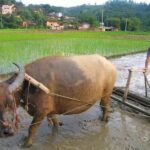
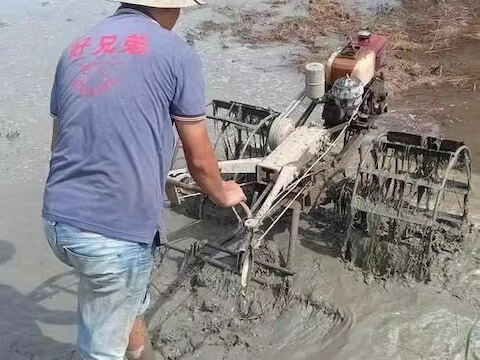
When the soil was ready, we began to sow the seedlings.
When the height of the seedling after seed germination reaches about 20 cm, we remove it from the mold. The water level depth of the sown farmland is about 3 cm. We plant seedlings in the field, usually at a distance of 15 cm. Each column is spaced at 20-30 cm. Such orderly planting is very tiring. We need to bend over and sow all the time, controlling the distance between the seedlings. To save time we usually stand in the paddy, hold some seedlings, and throw them directly into the soil with the rhizome part facing down. Although sowing in this way is not as beautiful as bending down to sow, the seedlings can survive, so don’t worry.

Fertilizing, weeding, and pest control
During the growth of the seedlings, we need to spend a lot of energy to take care of it. We need to keep the farmland moist throughout the growth process. During this period, we also need to fertilize, pull out weeds, and use special pesticides to eliminate pests in the farmland. This is a very important part of rice farming. If those pests are not dealt with, the growing seedlings will be their delicacy, and we will lose our crop.
Harvesting the rice
When the rice grains start to blossom and the blossoms start to grow, it means that the harvest day is not far away. The rice is harvested when the seed heads turn golden brown. Traditionally, rice was harvested by hand, but when I was a child, machine harvesting was also available.

What is manual rice harvesting?
Using a special harvesting knife, we cut the rice plants from the roots from the roots. Then we process the mature rice in batches through a semi-automatic machine to get the hulled rice. Then we separate the straw and rice for collection. This often takes a long time and is tiring. Because rice is planted in a large area, a family’s mature rice fed the whole family for a year. Part of the rice harvest was sold to the outside world.
What is machine rice harvesting?
When I was a child, there were machines that can harvest a large amount of rice in a short period of time. We had to pay some money to hire the harvesters. Then the workers will drive the machine to harvest the rice, and we can directly get the hulled rice grains. This can make things easier for us.
My memories
So what do we do after harvesting the rice grains? We need to clean up the straw scraps in the rice, and then on a sunny day, spread the rice evenly on the ground and let the sun dry the rice.
My strongest memories of rice farming in China as a child is the drying stage.
Most of the houses in rural Guangxi have flat roofs, surrounded by brick fences, so people can move freely on them. So we finish drying the rice there. I was very impressed with this because I was assigned to take care of the rice grains at home during the later stages of the rice harvest. The sun was bright and hot, but the dark clouds also popped up and then it rained suddenly.
When I saw dark clouds, I had to gather the rice grains into a pile as quickly as possible. Then I had to put them in bags or cover them with plastic wrap to protect them from the rain. If you put rice in a bag after getting rained on, the rice is likely to become moldy and spoiled. This is very serious because this is our food. If I didn’t pay attention to the weather and let the rice get wet, I’d be criticized by my mom. So even if I was watching cartoons indoors while the rice was drying, I had to pay attention to changes in the weather outside.
The fruits of labor
The last phase of rice farming in China is to store the dried rice.
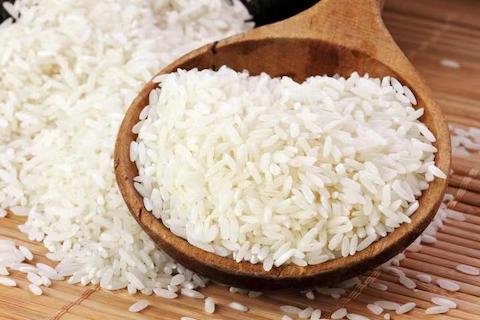
If all goes well and the weather is clear, a bag of rice can easily be sun-dried. How do I verify that it has dried? We can take some rice grains as an experiment. We crush them, and examine the inside texture of the rice, to see that there is no milky-white wet feeling. Next, we find a dry place to store it. During harvest time, we can get the rice that is used for cooking after shelling it by machine. When we eat grain obtained through our own labor, the taste is special, special and delicious.
Summary
With the development of science and technology, people are more committed to technology. This is good, science and technology can change people’s lives. Now, some areas of China have large areas of mechanized rice planting. This improves the efficiency of planting, reduces the loss of manpower, and increases the yield of rice. The downside is that the children now no longer know where the rice comes from. Even my 9-year-old niece, who lives in the countryside, doesn’t know how the rice she eats every day is produced, though the farmland is less than 1 km from her home.
Some farmers have already given up on growing rice, because the young people are working outside the home. Only the elderly and children remain in the home, so there is not enough laborers to grow rice. Therefore, some farmers have gone to the market to buy finished rice, and this phenomenon has begun to become common. To encourage farmers to plant, the state has distributed some subsidies from an early age to farmers who plant farmland. But as society developed, more and more farmers gave up farming because they were old. As their children migrated to the cities for work, the elders stay at home to take care of their grandchildren. Glenn is right to worry that one day, no one may know the original way of growing. If, one day, our machines no longer work, where do we go to get this high yield of food?
Do you enjoy My Chinese Home Kitchen?
We enjoy sharing these authentic home recipes with you. Learn more about My Chinese Home Kitchen at our About page.
Please leave a comment, or SUBSCRIBE to our newsletter.
For more of our original videos, visit My Chinese Home Kitchen on YouTube and Rumble.


Quite explanatory.
I won’t mind a more elaborate methodology of long rice mechanical farming.
Thank you.