

My joy of cooking authentic cuisine recipes is sharing the dishes with friends. I like to offer them delicious food they cannot get just anywhere. When I met Jing (静), I was excited at the opportunity to learn how to cook real Chinese food. Browse the recipes on My Chinese Home Kitchen, and you will see that food in modern China is a mix of traditional home-cooked family recipes, modern street food and snacks, and professional chefs combining aspects of the major cuisines to create exciting new dishes. Jing has taught me a lot over the last couple years. Through testing and practicing each of her recipes, I have learned a new way of cooking. Naturally, I began to think about hosting a Chinese dinner party.
Planning this dinner included the following steps:
- Choosing three main dishes that offered a variety of proteins and spiciness, but which could also be ready nearly simultaneously.
- Preparing all ingredients, including the marinades, ahead of time.
- Cooking the rice before cooking the entrees, and keeping it warm in the saucepan.
- Getting all of the dishes to the ready-to-finish stage before doing the last portion in the wok.
- Finishing each dish in rapid sequence and serving all while still warm.
Table of contents
- Factors to consider when planning a Chinese dinner party
- Choosing the menu for a Chinese dinner party
- Equipment list
- Grocery list for my Chinese dinner party
- Grocery items
- Special order items
- Toast and grind the Sichuan peppercorns
- Prepare the chili peppers
- Prepare the mushrooms, carrot, and broccoli
- Peel and chop the garlic
- Cook the rice
- Chop the coriander
- Slant-cut the beef
- Heat the oil, water, and the wok
- Cut the porkbelly and rinse the scallops
- Mix the sauce and starch water, get ready for cooking
- Cooking for a Chinese dinner party
- Enjoy your Chinese dinner party
- Do you enjoy My Chinese Home Kitchen?

Factors to consider when planning a Chinese dinner party
With most Western cuisines, a typical dinner party involves one main dish of several servings and a few sides, cooked simultaneously on the auxiliary burners. Everything is ready and served at the same time with relative ease. With Chinese dinners, it’s not as simple. Our recipes on My Chinese Home Kitchen are optimal for one or two servings each. One cannot simply double a recipe, however. For this, one needs a large commercial wok on a stove big enough and hot enough to accommodate such a large pan.
- The size of the typical home cooking range and the skillet or wok prevent cooking larger batches.
- Overloading a wok or skillet with too much volume on the typical home stove results in mushy, soggy, or poorly cooked food.
- Many of the dishes are cooked quickly, with several seasonings or ingredients added during the cooking process, so it is difficult to cook several dishes at once.

Choosing the menu for a Chinese dinner party
When planning my Chinese dinner party, I chose three main dishes and one side. My goal was to finish all three main dishes in rapid succession, so they could all be served simultaneously while still warm. To prepare and cook each dish individually takes 20 to 30 minutes, so doing each dish in sequence means the first dish would be cold, or sitting in the oven’s warming tray for an hour or so.
- I wanted to focus on home style recipes, and offer more than one type of protein. Most of our Chinese home recipes use either chicken, pork, or seafood, but Americans like beef. So, I included one professional recipe that uses beef.
- I chose two recipes that involve a two-stage cooking process: blanching then stir-frying to finish. This allowed me to use the auxiliary burners on the stove to heat the oil (dry blanching) and water, while cooking the first main dish.
- Finally, I wanted to include one vegetable side.
The beef tenderloin and the sauteed mushrooms with broccoli both require two-stage cooking. The beef and green peppers are dry-blanched in oil, and the broccoli is blanched in water.
Recipes chosen, in the order cooked
The fried pork belly with chili is delicious, and is very popular with my friends. I use Anaheim peppers or green bell peppers, or sometimes jalapenos. This dish is a Hakka recipe, and uses the unique approach of stir-frying the peppers, then browning the meat over low heat, finally using a small amount of the hot fat from the pork with Sichuan peppercorn, chili peppers, garlic, soy sauce, vinegar, and Pixian Doubanjiang to add flavor. While the pork is slowly browning, I can set up the oil and water for blanching the ingredients for the other dishes.

Most Americans love beef, and this professional restaurant style dish is very popular. The marinade makes the beef very tender and gives it a delicious flavor. The time consuming part of this recipe is the preparation and blanching in hot oil. I use my Dutch oven to blanch the beef and green bell peppers. While the oil is heating I can work with the wok on the main burner to brown the pork belly and then finish the pork belly with chili dish.

This recipe cooks fast, in two minutes and 30 seconds, once the wok is hot. I chose it as the last of the three main entrees partly for this reason, and because it’s very simple to make. Jing’s recipe uses squid tentacles. I substitute scallops because I find that while my friends will eat calamari, they are turned off by the idea of squid tentacles.

This is a very nutritious dish, and rounds out the meal with a good, healthy dose of vegetables. The seasoning is simple, but delicious. I start the water boiling, which takes a while. With my stove, I can boil water with a magnifying glass on a sunny day about as fast. The broccoli only needs to blanch for 30 seconds, but the water can boil until I’m ready to do the vegetables. These can be done in the wok after the scallops, or, you blanch the broccoli while you blanch the beef, then use a skillet to cook the vegetables while you wait for the beef broth to come to a boil in the wok. If you do this, though, you have to be quick and watch both pans.

Equipment list
One nice thing about home-cooked Chinese dishes is that if you have a hot burner, chef’s knife, cutting board, wok, and a spatula, you have all you need for most recipes. Even rice can be cooked in a wok. If you don’t have a wok, a good cast-iron skillet with deep sides will suffice. For these recipes, I used:
- 14-inch, flat-bottom, carbon-steel wok, properly seasoned
- A wok spatula
- A radial “spider-web” skimmer
- A western style kitchen knife, scalpel sharp
- A wooden cutting board
- An instant-read digital thermometer
- A 3-quart saucepan for blanching the broccoli
- A 1.5-quart saucepan for cooking the rice
- A 1-cup pyrex measuring cup
- A 4-cup pyrex measuring cup (for hot oil)–any heat proof container will do
- A 4-quart Dutch oven (for blanching the beef in oil)–you can do this in the wok, but you have to remove the hot oil to a heat-proof container to continue using the wok
- A 10-inch cast-iron skillet (optional)


Grocery list for my Chinese dinner party
Most of the ingredients used in these recipes can be purchased in any grocery store. However, some of the seasoning items and the chili peppers need to be special ordered, unless you live near an Asian grocery.
I strongly recommend ordering specialty ingredients online, or visiting a good Asian grocer. The first time I used an off-the-shelf soy sauce from the local grocery in one of Jing’s recipes, the food was too salty to eat and I had not added any actual salt. Most are available online from The Mala Market, a mother-daughter business located near Nashville, TN. Their prices are a bit higher than what you might find on Amazon, but their quality is the best I have found.
Grocery items
- 1 pound lean beef
- 1 pound frozen scallops
- 1 pound pork belly (not bacon–use pork belly)
- 5 green bell peppers
- 5 green onions
- 1 bunch, broccoli
- 8 ounces common white mushrooms
- 2 carrots
- 1 bunch fresh cilantro
- fresh ginger
- 3 bunches garlic
- dried, ground cumin
- white sugar
- ground white pepper
- salt
- corn starch
- baking soda
- long grain white rice
- toasted, pure sesame oil (not blended with other oils)
- peanut oil or canola oil
Special order items
- Light soy sauce (Zhongba, Pearl River Bridge, Lee Kum Kee)
- Dark soy sauce (Zhongba, Pearl River Bridge, Lee Kum Kee)
- Megachef Oyster Sauce (the real deal, not a glop of corn syrup flavored with additives and colored with caramel).
- Pixian Doubanjiang (Sichuan red bean paste, available at Yami and Amazon.)
- Laoganma Chili Oil with Black Bean (I have found this available only on Amazon.)
- Sichuan Peppercorn (Huājiāo 花椒)
- Xiaomila “millet” chili peppers (Mexican chile de arbol, or Thai chilies are a substitute. The Thai peppers are hotter. The chile de arbol is similar, but not the same as the xiaomila.)
- Shaoxing Wine (or dry sherry)
- Baoning Vinegar (or white vinegar)
My Chinese Home Kitchen does not receive any royalties or commissions for recommending these products.
Preparing the ingredients for a Chinese dinner party
Cooking for a Chinese dinner party is more work than you would expend with most home-cooked meals. The length of this article might make you think it’s too much bother. However, with a bit of planning and orderly preparation, what French chefs call mise en place, the cooking comes together quickly and smoothly. Most of your time will be spent on preparation, but the results are worth the effort. With a bit of practice, you can pull off a dinner that has my guests asking to bring home the leftovers.
I find it best to prepare all ingredients, and put them on plates, in the groupings by which they will be added to a particular recipe, then set all these together with the recipe instructions for that dish. This uses a bit of counter space, but it helps keep everything organized.
One day before your dinner, set any frozen items out to thaw. The scallops will thaw overnight in the refrigerator. If the beef or pork belly is frozen, you can set it in the refrigerator overnight, and check it before you begin preparing ingredients. If still partly frozen, set them out at room temperature.
Get out five green bell peppers, five green onions, 3 to 4 bunches of garlic, fresh ginger, broccoli, mushrooms, carrot, cilantro, 9 xiaomila peppers, and 10 Sichuan peppercorns. Wash the vegetables.
Toast and grind the Sichuan peppercorns
Put the Sichuan peppercorns on a dry cast-iron skillet over medium-low heat to brown them slightly. Turn occasionally. You can work on preparing other ingredients while these are toasting. When they begin to darken (do not burn them), remove and grind them into a powder, then set this on a small plate.


Prepare the chili peppers
Take three xiaomila peppers, cut the stems, and chop them into small pieces. Place these on the plate with the ground Sichuan peppercorns, for the porkbelly dish.
Take the remaining six xiaomila peppers, cut the stems, but do not chop them. Then place these on a small plate.
Prepare the mushrooms, carrot, and broccoli
Snap the stems off the mushrooms, slice the caps, set aside on a plate. Peel the carrot, cut off the ends, cut the carrot into two inch lengths and then cut these into slices, then set them on the plate with the mushrooms. Cut the broccoli florets into bite-sized pieces, then set on a plate. Peel one green onion, trim the roots, and cut diagonally into 1.5 inch lengths, then set on a plate. Set these aside with the recipe instructions for the Sautéed Mushrooms with Broccoli.
Peel and chop the garlic
Break off 13 medium to large garlic cloves, trim the root end, crush with the flat of the knife, then peel. Throw away the garlic peels, then chop the garlic.
When chopped, a clove of garlic is equal to about 1 teaspoon (5 ml). I sort the garlic into three groups before chopping: 4 cloves for the scallops, 6 for the beef, and 3 for the porkbelly. Then I chop them and put them on three small plates.
The 4 garlic cloves for the scallops go on the plate with the 6 xiaomila peppers, as they will be added simultaneously when cooking the scallops.
On the plate with three garlic cloves for the porkbelly, add 1 teaspoon (5 ml) of white sugar.
Chop the two remaining green onions
Peel away any dead leaves, cut off the roots, then chop into small pieces. Place these on the plate with the six garlic cloves for the beef.
Mince the ginger
The amount of ginger for the beef is subject to your tastes. I find that approximately 1 tablespoon (15 ml) is good. Peel a length of ginger about half the length of your thumb, then slice five or six slices, the thickness of a coin. Mince these by smashing them on your cutting board the handle of your knife or a meat tenderizing mallet. (See our video.)


Jing likes to leave the ginger in slices, but I prefer to mince it. Both methods will impart the flavor to the dish. Chinese use ginger to remove the “fishy” smell from meat. By this, they mean the odor and taste of blood in the meat. Ginger also contains and enzyme that tenderizes meat. I like the flavor of ginger, and I like it blended into the sauce, so I mince the ginger.
Cut the green peppers
Take two bell peppers, remove the stem and seeds, and cut julienne style into 1/4-inch strips. Place on a large dinner plate and set aside. The the other three peppers (Anaheim, or bell peppers, your choice), remove the stems and seeds, and cut into bite-sized pieces. Place these on a second large dinner plate and set aside.


Cook the rice
I cook the rice first, because I don’t have a rice cooker. So, I need to use a saucepan, and I want to keep my stove burners free when cooking the main dishes. I use Grace Young’s classic rice recipe.
Measure out about 1 1/3 cups of rice. Rinse the rice with cold water until the water is clear. This removes the starch and makes the rice less mushy and sticky. This is important if you want to make fried rice from the leftover rice tomorrow. Cover the rice with water up to the first joint of your index finger, place on a burner, and bring to a boil. Let the rice boil until the water disappears and dimples begin to form in the rice. Then turn the heat to low, cover the saucepan, and set your timer for ten minutes.


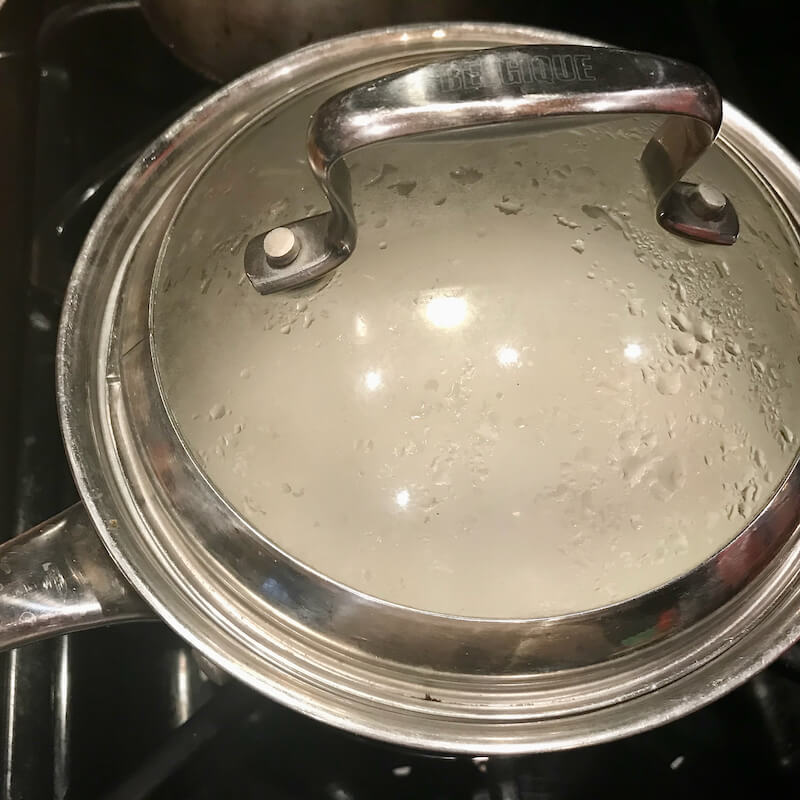

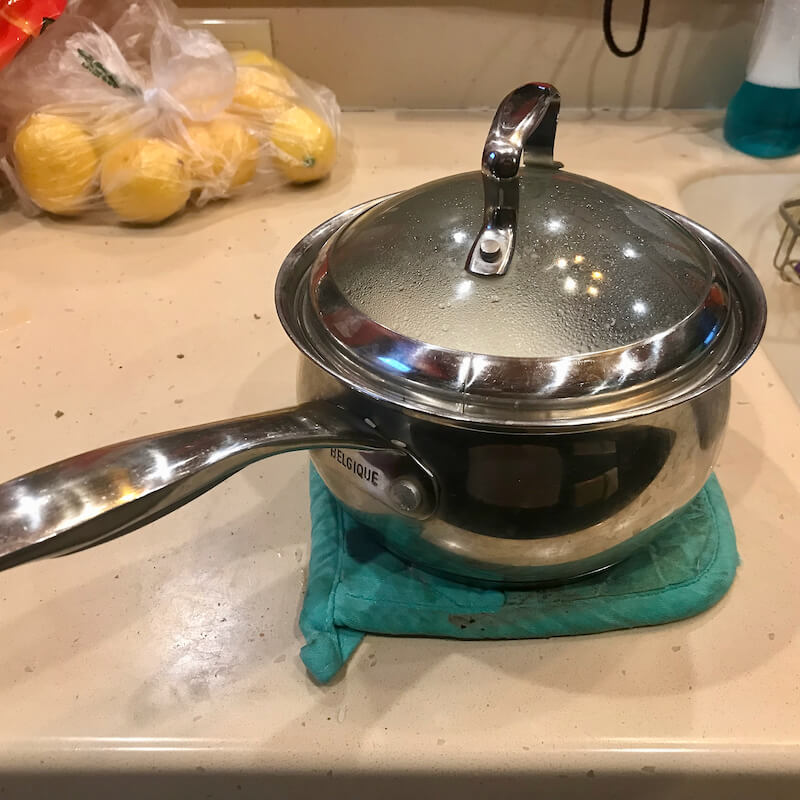
Keep working on your preparation. When the timer rings, turn off the burner, fluff the rice with a fork, place the lid on the pan and set aside on a trivet or oven mitt until you are ready to serve the food.
Chop the coriander
Take the bunch of coriander (cilantro), and chop off the leaves, then using a mincing chop, mince the coriander into small pieces. Set on a plate with the scallops.
Slant-cut the beef
For the beef tenderloin, I usually use a lean steak, such as sirloin. However, my local grocery tends to cut steaks too thin, so I use a slant-cut technique to get beef slices that are about 1 inch wide.

Place the beef slices in a bowl, mix the marinade according to the recipe, and stir into the beef to mix well. Then set it aside.
Heat the oil, water, and the wok
Clear the stove, place your wok on the main burner, and a Dutch oven on one of the auxiliary burners. Place a three-quart saucepan about half full of water on the back burner. Set the flame on high under the oil and the water.
Set the flame on high under the wok. Continue with your preparation (cutting the porkbelly), but watch the oil and the wok. The oil needs to be between 194 and 248 degrees F. If the wok begins to smoke, swirl a tablespoon of cooking oil in the wok to coat the bottom and sides, pour off the oil, and turn the flame to low. If the oil begins to get too hot, turn off the flame or reduce heat to low as appropriate.

Cut the porkbelly and rinse the scallops
Open the package of scallops, pour them into a sieve, and rinse under cold water until clear, then set aside to drain.
Take the porkbelly and cut lengthwise into strips about 1/4 inch thick. Then lay these flat and cut across them into 1/4 inch pieces. Set on a plate and set aside.
Mix the sauce and starch water, get ready for cooking
The vegetables need a small amount of water to simmer, and a bit of starch to turn the water into a glaze. The beef requires a sauce of water, sugar, wine, soy sauce, and oyster sauce, and this will be thickened with starch too. In her recipe, Jing leaves the exact quantities to your personal taste, so I’ve included my ratios below.


- Measure two tablespoons (30 ml) of water into a bowl and set aside with the mushrooms.
- Measure two tablespoons of starch into a bowl, add four tablespoons (60 ml) water, and mix with a whisk. Set this aside, near your wok.
- Take a measuring cup, add 4 oz of water (115 ml), 1/2 tablespoon (7.5 ml) sugar, 2 teaspoons (10 ml) each of light soy sauce and oyster sauce, 1 teaspoon (5 ml) dark soy sauce, and 3 teaspoons (15 ml) Shaoxing wine. Mix well with a whisk until the sugar is dissolved, and set aside with the ingredients for the beef.
- Set near your wok: sesame oil (for finishing the beef), light soy sauce, dark soy sauce, oyster sauce, Pixian doubanjiang, Laoganma chili oil with black beans, and Baoning vinegar. Leave room to work, but have these handy, and a set of measuring spoons. When you are cooking the porkbelly and the scallops, you will use these to season the dish, and they need to be added quickly while you are stir-frying.
- Keep the whisk handy, near the sauce and starch, to stir again before adding.
Cooking for a Chinese dinner party
You have planned your Chinese dinner party menu, done your shopping, spent a couple hours getting everything prepared. Now it’s time to cook and serve!
The first dish we’ll cook is the porkbelly, and while the pork is browning, we will blanch the beef, pepper strips, and broccoli.
Blanch the beef, pepper strips and broccoli while browning the porkbelly

- Turn the flame under the wok to high. When it is hot enough that a drop of water vaporizes in 1 second, add about 10 ml (2 tsp) oil to the wok, and stir fry the green pepper chunks for the porkbelly. Stir-fry for three minutes. Remove and set aside. Reduce the flame to medium low, and add the porkbelly pieces.
- When the oil is heated to around the boiling point of water (not deep fry temperature), add the beef and stir to separate. Blanch the beef until the color changes. While the beef is blanching, stir the pork belly occasionally. Don’t fry it to a crisp, but brown it lightly and extract the fat. Meanwhile, add the broccoli to the boiling water for 30 seconds.
- Pour the broccoli into a sieve, and set aside to drain. Scoop the beef from the oil with the skimmer, letting the oil drain back into the Dutch oven. Set aside, and then blanch the green pepper strips for 15 seconds. Scoop these out with the skimmer, turn off the heat for the oil. Set a trivet or oven mitt on the counter out of the way, and move the Dutch oven off the stove to cool.
- Keep stirring the pork to brown it evenly. When it is done, remove the pork and place on the plate with the pepper chunks. Drain off all the hot fat except for about 1 tablespoon (15 ml).
Finish the porkbelly

- Turn the flame to high, and add the dried chili peppers with the ground Sichuan peppercorn. Stir quickly for a few seconds until fragrant, and add 2 teaspoons (10 ml) of doubanjiang. Keep stirring quickly while the oil in the bean paste begins to liquefy and blend with the fat in the pan.
- Add the pepper chunks and porkbelly to the wok, stirring quickly to combine. Add 1 teaspoon (5 ml) of light soy sauce, 3/4 tsp (4 ml) vinegar, and the garlic with the sugar. Stir quickly to combine. Stir-fry for 2 minutes to finish, and transfer to a serving dish.
- Rinse the wok under the faucet. If any bit stick to the wok, use a steel wool or nylon scrubber. DO NOT USE DISH SOAP! Wipe the wok dry with a towel, return to the burner on high flame.
Finish the beef, start the vegetables

This takes a bit of coordination, so you may want to do this in sequence.
- Put a cast iron skillet on an auxiliary burner with flame on high while the wok is heating. When it is hot, add 20 ml of oil (1 tbsp + 1 tsp) and swirl to coat the pan, then add the green onion. Stir quickly for a few seconds until fragrant, then add the mushrooms and carrots and stir quickly. Let it cook until the mushrooms begin to soften.
- While the mushrooms and carrots are cooking, swirl a teaspoon of oil (5 ml) in the wok, add the ginger, garlic and green onion, and stir fry for a few seconds until fragrant. Whisk the sauce prepared earlier and add to the wok. Let it come to a boil.
- Stir the mushrooms and carrots, add the broccoli and stir to combine. Add the water, 1.5 tsp oyster sauce (7 ml), 1 tsp light soy sauce (5 ml), 1/2 tsp (3 ml) white pepper, and salt to taste. Stir quickly then thicken with a few drops of starch water to glaze the vegetables, and remove from heat.
- Add the beef to the boiling sauce in the wok. Stir well to mix. Add the green peppers. Stir well to mix. When the sauce returns to a boil, add starch water, a little at a time while stirring constantly, until the sauce forms a nice glaze, but not so much that it is thick like snot. Then add 1 tsp (5 ml) of toasted sesame oil, stir to combine, and transfer to a serving dish.
Cook the scallops
- Rinse the wok thoroughly, as before. Do not use any soap! Dry and return to the burner on high.
- When the wok is hot, swirl 2 teaspoons of oil (10 ml) in the wok to coat the bottom and sides. Then add the dried chili and minced garlic, stir-frying quickly for a few seconds until fragrant. Add the scallops, 1/2 tsp light soy sauce (3 ml) and 1 tsp (5 ml) oyster sauce and stir-fry quickly to combine.
- Add 1 teaspoon of Laoganma (5 ml) and 1/2 teaspoon (3 ml) ground cumin, stirring quickly to combine. Stir fry for 2 minutes. Add the cilantro and stir-fry for 30 seconds to finish.
- Transfer to a serving dish, turn off the flame, rinse the wok thoroughly and wipe dry with a towel.
Enjoy your Chinese dinner party
As you can see, a lot of work goes into the preparation. If you keep the ingredients together you can cook them all quickly and efficiently, serving them all while still hot.
We also took advantage of the four burners on the Western stove. Most Chinese homes do not have stoves as big as a Western home kitchen, and few have ovens. We used the extra burners to do the blanching pre-cooking for two dishes, while cooking the main dishes in the wok.
The secret to impressing your friends with a small smorgasbord of dishes is careful planning and thorough preparation. I usually do my preparation in the mid-afternoon, so I have some time before I have to start cooking.
Please let us know your thoughts and experience in the comments below, and feel free to ask any questions!
Do you enjoy My Chinese Home Kitchen?
We enjoy sharing these authentic home recipes with you. My Chinese Home Kitchen is a labor of love.
Please tell your friends about us!
Learn more about My Chinese Home Kitchen at our About page.
Please leave a comment, or SUBSCRIBE to our newsletter.
For more of our original videos, visit My Chinese Home Kitchen on YouTube and Rumble.


Dear Chen Jing ,
Why your pages cannot be copied and saved your recipes ? Please check why ?
Thanks
Best regards
James Lee
Greetings James,
Thank you for your question.
We do not charge any fees for the content on My Chinese Home Kitchen, but that doesn’t mean the site costs us nothing. It is actually quite expensive to produce our content: labor, time, travel expenses, web hosting costs, software licenses, photography, and salaries all add to the annual operating expense.
Shortly after we launched the site, we found that some individuals were using a technique called “content scraping” to steal our content, and thus our traffic, so they could increase their own traffic and ad revenue, thus profiting at our expense.
So, we now block sites from stealing our content.
For readers such as yourself, recipes can be printed. Also, the pages can be printed. If you enjoy an article, such as this one, and wish to keep a copy, use your browser’s print function. From the print screen, you can save to PDF or print to a physical printer.
Future plans:
We are planning to add a feature allowing readers to save their favorite recipes into personal collections. This will allow readers to keep those recipes, but will require a login account. Since this is a premium service, we will probably charge a nominal subscription fee for this service. This is necessary to keep bots away.
Best regards,
Glenn Emerson
I’m so glad to see you’re hosting a Chinese dinner party! I think it’s so important to celebrate the cultures of our friends family, and neighbors. It’s wonderful that you’re sharing your culture with your friends and family.
Thank you for your support. Please spread the word about our site.