

Hi guys! My name is Chen Jing. I’m so glad I’m back in My Chinese Home Kitchen! For the past half year, I have been very busy at school. As graduation approached, my studies became much busier. I did not have much energy to put into publishing content on the website. A big thank you to Glenn for all the work he puts into this site! He is really great! Thanks for your hard work!

What I want to share with you is that I graduated from New Oriental Cooking School in May 2024! After nearly three years of study, I have learned a lot about Chinese cooking. When you learn a cooking technique, combined with the study of ingredients, you can make a delicious dish. I learned that cooking does not rely on recipes but on mastering cooking techniques. I am very grateful to my cooking teacher, Mr. Zhu Jinge. He said that a dish can have a hundred flavors, and people who like that taste will praise the dish. So as chefs, we need to be flexible in cooking and strive to please more people with the dishes we cook.
Dishes for banquet exhibition
In March we started a new course: the One-month Chinese Banquet Course. We had to make a complete banquet dish for exhibition. The banquet menu changes weekly. These banquet dishes are placed in the exhibition hall for visitors to the school. For the sake of aesthetics, the dishes need to be replaced with fresh ingredients every day.
We learned how to customize the dishes according to the theme of the Chinese banquet, and to control the cost of the banquet. For example, a wedding banquet, a birthday banquet, or a celebration banquet. We learned how to garnish a dish, to make the dish look simple yet classy. A banquet includes hot dishes, cold dishes, soup, fruits, snacks, and staple food. In the first week, we made dishes according to the menu given by the teacher. Starting in the second week, we had to plan our own dishes for the banquet, based on the instructor’s suggestions.
There were 29 people in our class, divided into 4 groups. Each group was responsible for several dishes.
First week
During my first week I was responsible for a dish called Stewed Lion’s Head. This is a famous traditional dish in Jiangsu. It’s actually minced pork and made into meatballs. Because the meatballs are large, they are named “lion heads”. Since it is a dish for exhibition, more emphasis is placed on aesthetics and cost savings. Therefore, the selection of ingredients is more simple. The ingredient I use is pork, and the ratio of fat to lean is 3:7. I cut the pork into grains and then mince briefly. Then I add salt to the meat filling and stir clockwise until there is resistance, then add starch water. I stirred it evenly again and formed the meat into larger spherical meatballs. To cook them I first brought the water to a boil and then turned off the heat, then added the meatballs. When the surface of the meatballs is set, I cooked them over low heat for 1 hour, keeping the water at a slight boil. The foam needs to be skimmed several times during the cooking process, to keep the soup clear.
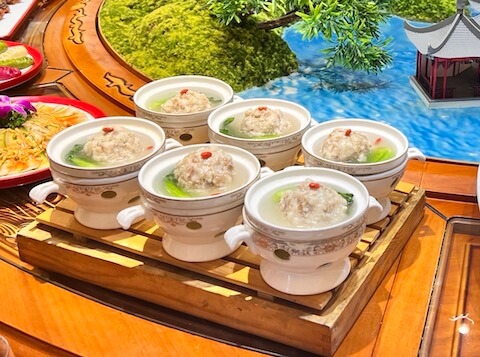
Finally, I removed the meatballs and put them into a soup pot, added some blanched bok choy and wolfberries as decoration. Then I added the broth in which the meatballs were cooked, and it’s done.
Second week
During the second week I was responsible for making Jin Tang Yu Sun. This is the name of the dish I chose myself. “Jin Tang” means golden or yellow soup. It is cooked pumpkin, crushed into pumpkin puree with a blender, and then fried with oil over low heat to dry out the water in the pumpkin puree. I let the oil blend into the pumpkin puree, making it smooth and shiny, and better preserved. When I need to use it, I will take out a portion, add an appropriate amount of water, and then add starch water to thicken the soup.
“Yu Sun” means bamboo shoots. I added red yeast rice to the pork skin and cooked it, and I got a piece of pork with reddish-purple skin. I only use the fat part, which is about 1-1.5cm thick. Then use a heavy object to flatten the pig skin. I placed it in the freezer to make it easier to cut. When the pork is frozen hard, I can slice the pork into thin slices more easily. The slices here need to be cut evenly. In this way, the bamboo shoot tips will look more beautiful when wrapped. I used some white jade mushrooms, peas, and shrimp as decoration for the final product.
The “bamboo shoots” part of this dish was inspired by my banquet instructor, Mr. Zhao. He is the original originator of this practice.

Third week
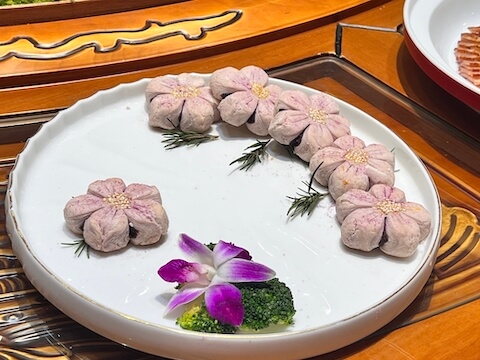
In the third week, I was responsible for making peach blossom cake desserts. This is a common pastry, made using two types of dough. Dough 1 is made from water, lard, and flour. Dough 2 is made from lard and flour. I wrapped dough 2 with dough 1, rolled it out, folded it, and repeated this 3 times. Then I added the filling (bean paste), and cut it with a knife to make a peach blossom shape. Then I spread some egg yolk liquid in the center and sprinkled some sesame seeds. The cakes are placed in the oven to bake. To make the peach blossom cake colorful, I first used purple sweet potato flour and added it to the flour, so the peach blossom cake has some lavender color. The second time I made it I used fresh dragon juice for dyeing. So I got the pink peach blossom cake.

Fourth week
During the fourth and final week, I was in charge of the dessert part of the banquet. Papaya custard. I chose papaya as the main ingredient. This is another low cost and easy to make dish. I melted the gelatine in cold water, heated the milk, and added the gelatine, mixing well. I removed the narrow end of the papaya and scooped out the seeds from the papaya. Then I poured the milk-gelatine mixture into the papaya. I wrapped it with plastic wrap to seal it and refrigerated it for 3-4 hours. Once the custard filling was set, I took the papaya out of the refrigerator, peeled it, and cut it into the desired shape. I decorated with mint leaves and blueberries, then I drizzled it with honey and osmanthus sauce, and my papaya dessert was completed.

It is worth mentioning that this dessert received high praise from Teacher Zhao. He said it was a creative dish.
The banquet dishes made by classmates
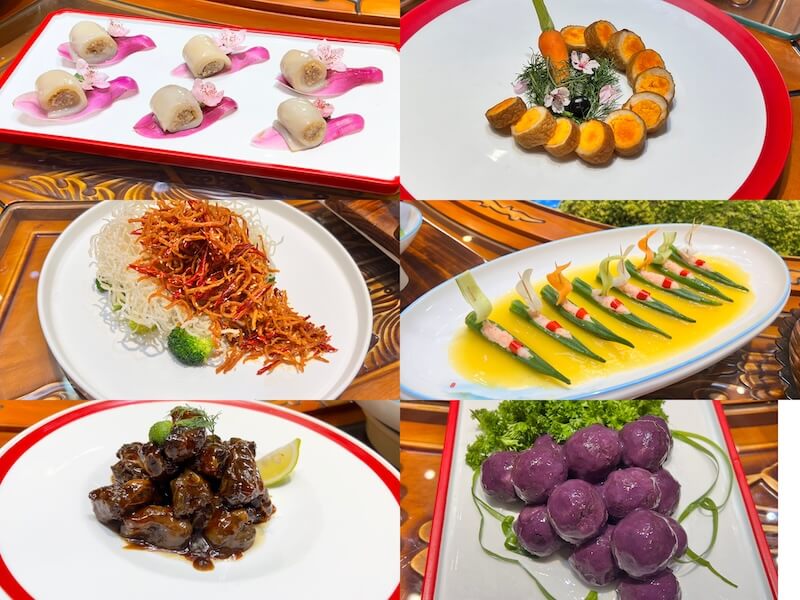
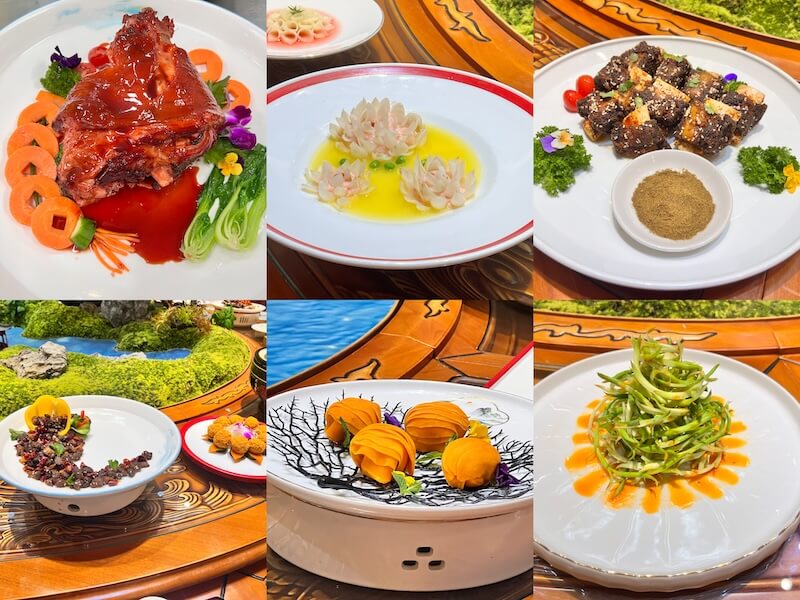
These are some of the banquet dishes made by other students. My classmates are very good, and we complete the banquet tasks every week together. We learn from each other and give each other advice. We have made progress together.
Certificate and licenses
During the three years of studying cooking at New Oriental, persistence and hard work have paid off. I completed all courses, passed various skills examinations, and obtained three relevant license certificates: Chinese cuisine chef, Western cuisine chef, and Chinese pastry chef. These chefs licenses are certified through the official website of China Skilled Talents. There are five license levels for each license type. Level one are true masters, after many years of study and work. Our teacher, Mr. Zhu is level two after many years of restaurant experience and publishing recipe books. As professionally trained students, we start at level four.


I can now say that I am a chef! My dream has not changed. I still dream of becoming a better chef and bringing more delicious food to everyone! There is no end to learning, I will still learn more and hope to make progress every day!
Thank you all for your loyal readership. I will bring more interesting articles and delicious recipes in the near future. Please stay tuned to My Chinese Home Kitchen!
Recipes in this post
Do you enjoy My Chinese Home Kitchen?
We enjoy sharing these authentic home recipes with you. My Chinese Home Kitchen is a labor of love.
Please tell your friends about us!
Learn more about My Chinese Home Kitchen at our About page.
Please leave a comment, or SUBSCRIBE to our newsletter.
For more of our original videos, visit My Chinese Home Kitchen on YouTube and Rumble.


CONGRATULATIONS!!!!!! This is HUGE!!!! Well done!!!!! Looking forward to your new chapter!!!!
Congratulations Chef, on passing your course, and wishing you further success in reaching the heights of your profession. Love your recipes.