

We have been a little slow with posting lately. Jing has been in school every weekend for the past month. She is finishing the last of her classes and will be finished with her classroom culinary training in April. One of her recently class projects was to prepare this simple but elegant papaya dessert. Jing sent me a couple photos and the instructions for these custard-filled papaya slices, and it is quite easy to make. As desserts go, this is a very healthy one. Papaya is loaded with vitamins C & A, folate (B9), potassium, and antioxidants. While the research is not conclusive, studies suggest the lycopene in papaya can reduce cancer risk. However, since this dessert is made with raw papaya, it’s important to choose a ripe fruit.

Making custard-filled papaya slices
To make custard-filled papaya slices, start with a ripe papaya (ripeness is important). Cut slices off the narrow (top) end of the papaya until you expose the seed cavity. Slice across the bottom end just enough so the papaya will stand upright, but do not remove too much and expose the bottom end of the seed cavity. You have just turned the papaya into an upright, open-ended bottle.
Use a spoon to scoop out all the seeds. Add a packet of unflavored gelatin to 50 ml cold water, and let it stand for one minute. Meanwhile, bring the milk to a simmer on the stove. Stir the gelatin-water into the milk and stir well until thoroughly dissolved. Finally, pour the hot milk into the hollowed out papaya, and set it in the refrigerator for several hours or overnight until the milk sets and becomes firm.
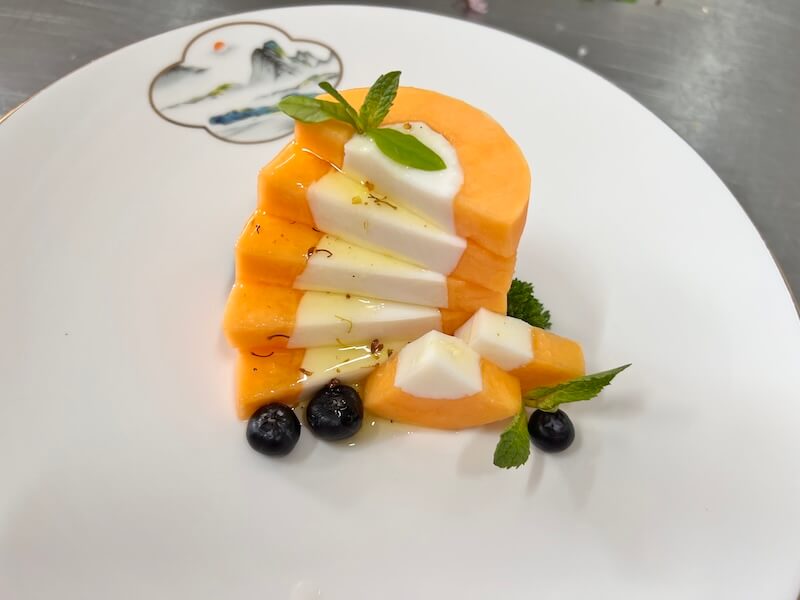
Once the milk is set, peel the papaya then cut across the papaya to make thick slices about 1/2 inch (13 mm) thick. Halve or quarter these, as you see fit. Arrange these on the plate, drizzle with the honey osmanthus sauce, and garish with berries and mint leaves.
Use ripe papaya
I have never made a papaya dessert recipe. I grew up in the northeast, and we did not have fresh papaya in the stores. Papaya is common in the grocery stores here in Texas, so I did a little research on how to choose a good, ripe papaya.
An unripe papaya has a green skin, and the flesh is firm. Like plums or peaches, when a papaya is ripe you can press your fingers into the flesh easily. The skin turns yellow or orange as the fruit ripens.
According to WebMD, eating unripe papaya can be dangerous. “The unripe papaya fruit is possibly unsafe. Unripe papaya fruit contains papaya latex, which contains an enzyme called papain. Taking large amounts of papain might damage the esophagus.” Many recipes that use green or unripe papaya call for baking or cooking the fruit.
To ripen a papaya, let it sit out at room temperature until the skin begins to yellow and the flesh becomes soft. Placing a papaya in a closed brown paper bag with apples can help expedite the ripening process.
NOTE: You can read more about selecting a quality papaya at Martha Stewart’s site.
Health benefits of papaya
While the research into the health claims for papaya is ongoing, it is generally accepted that papaya lowers blood sugar, reduces cancer risk, has powerful antioxidants, and may improve heart health and reduce inflammation. There is a growing awareness in the health community that chronic inflammation, caused by the metabolic consequences of the modern Western diet, are the root cause of many diseases.
NOTE: You can read more about the evidence for health benefits of papaya at Healthline.
While papaya is very healthy, it can also have interactions with certain medications. Mainly, these seem to apply to people taking papaya extracts as a nutritional supplement, not consuming it in normal food amounts. If you are on diabetic drugs to lower blood sugar, taking a blood thinner like warfarin (Coumadin), or thyroid hormones such as Levothyroxine, or Amiodarone for heart arrythmia, there are potential risks of interaction, according to WebMD, so please consult your physician if this applies to you.
Osmanthus sauce
There are several recipes for osmanthus sauce. Osmanthus sauce is used in many traditional Chinese deserts. Essentially it is a simple syrup (sugar and water, or honey and water) infused with osmanthus flowers (Amazon). Basically, you use about 2 parts sugar to 1 part water, with a very small amount of salt.
IMPORTANT: Be sure to use a glass canning jar with a good seal. Wash and rinse and then submerse the jar in a pot of water and boil for several minutes to sterilize. You can keep your osmanthus sauce in the refrigerator for some time, but sugars do promote bacteria and mold growth so it’s important to sanitize the jar. Osmanthus sauce should be clear. If it becomes cloudy, discard.
Some recipes call for boiling the osmanthus leaves in water, then adding the sugar and salt and honey, stirring until the sugar is dissolved. Others call for making the simple syrup by dissolving the sugar in boiling water, transferring the syrup to the sterilized jar, and then mixing in the osmanthus petals and honey. Yet another calls for rinsing the osmanthus, adding a small amount of salt, then alternately layering the osmanthus petals and honey in the jar.
Here are a few links to various recipes and methods:
- https://whattocooktoday.com/osmanthus-syrup.html
- https://simplechinesefood.com/recipe/honey-osmanthus-sauce
- https://simplechinesefood.com/recipe/osmanthus-sauce
- https://www.greedygirlgourmet.com/easiest-infused-osmanthus-sugar-syrup-recipe/
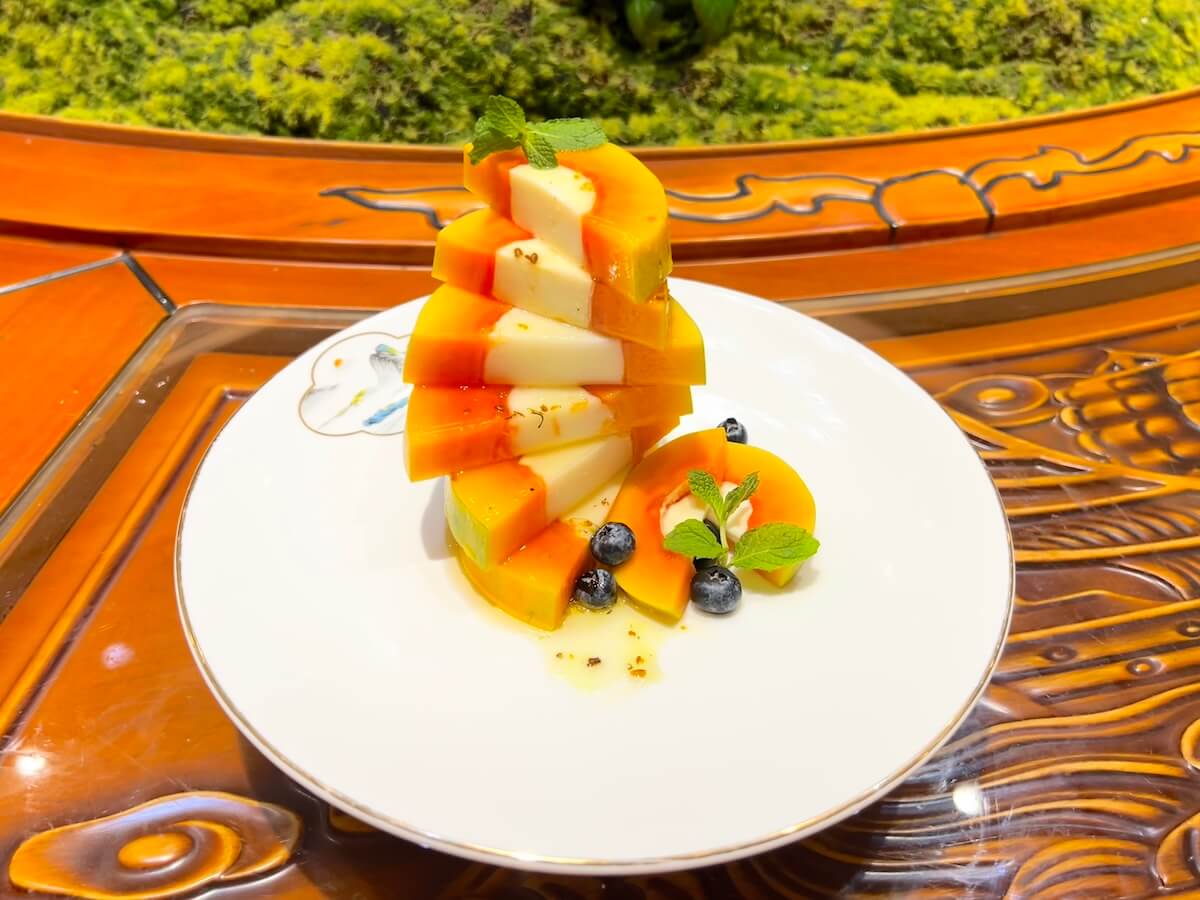
Jing’s Custard-filled Papaya Slices

Equipment
- 1 1.5 quart saucepan
- 2 measuring cups
- 1 rubber spatula
- 1 plate
Ingredients
- 1 papaya (ripe)
For the custard
- 2 cups whole milk
- ¼ cup cold water
- 1 pouch Knox unflavored gelatin 7 grams or 2½ teaspoons
For the topping
- osmanthus syrup with honey drizzle lightly
- 4-6 blueberries
- 3-4 mint leaves (optional garnish)
Instructions
Prepare the papaya
- Choose a ripe papaya, with the skin yellow to orange, and the flesh soft to the touch.1 papaya
- From the bottom, or wide end, of the papaya, cut a thin slice crosswise to give the papaya a flat bottom. At the narrower end or top, cut crosswise to expose the seed cavity. Remove thin slices until just enough of the papaya top is cut away.
- Use a spoon to scoop out the seeds. (The seeds are not used in this recipe, but they are edible if you choose.) Stand the papaya upright on end. (You have just made an open-top upright bottle.)
Making the custard
- Measure ¼ cup (50 ml) of cold water in a measuring cup. Sprinkle the gelatin powder on the water. Let it stand one minute. This separates the granules and avoids creating lumps. Do not skip this step.¼ cup cold water, 1 pouch Knox unflavored gelatin
- Measure 2 cups (500 ml) of whole milk and pour into the saucepan. Heat the milk, but do not boil or scald.2 cups whole milk
- Add the water and gelatin to the milk when the milk is hot. Stir well with the rubber spatula until the gelatin is completely dissolved, at least 2 minutes. Stir gently, do not splash the liquid on the sides, or the granules will just stick to the side of the pan. Use the spatula to scrape the sides and bottom of the pan as you stir to keep the gelatin granules from settling.
- When the gelatin is completely dissolved, pour the hot milk into the hollowed out papaya. Wrap the whole papaya in plastic wrap. Then place the papaya, standing upright, into the refrigerator.
Serving
- When the milk has firmed to the consistency of jelly or pudding, remove the papaya from the refrigerator. Using a sharp knife or vegetable peeler, skin the papaya carefully. The skin is very thin, so be careful not to cut too deep if using a knife.
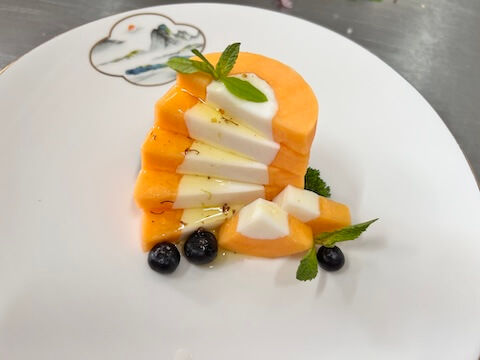
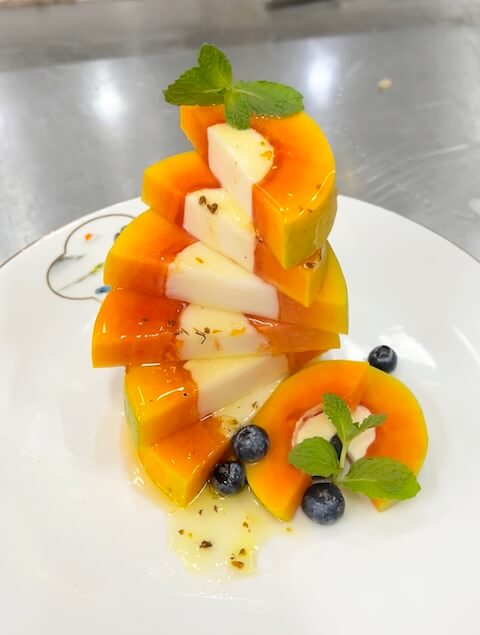
- Using a sharp knife, cut the papaya cross-wise into slices about ½-inch (13 mm) thick. Halve or quarter the slices as shown.

- Carefully stack the slices as shown, or arrange in whatever manner pleases you.
- Lightly drizzle the slices with the osmanthus syrup and honey. This is very sweet, so drizzle sparingly.osmanthus syrup with honey
- Garnish with fruit, mint leaves, etc. and place it back in the refrigerator until you are ready to serve.4-6 blueberries, 3-4 mint leaves

Notes
- Papaya has protease enzymes that will break down the collagen in gelatin. The heat from the milk helps to inactivate these enzymes.
- To avoid lumps in the gelatin, it’s important to separate the granules before dissolving. Pouring the powder into the cold water, and letting it stand for a minute separates the granules. This is an important step. Adding the gelatin powder directly to hot liquid will cause lumps to form.
- You can buy osmanthus syrup, or make your own. If using homemade, make it ahead of time to let the flavor develop.
- A sharp knife is important. Ripe papaya is soft, and a dull knife will bruise or mash the papaya as you try to slice.
- You can let the milk custard filling set overnight if you want. It may take longer than four hours for it to reach the desired consistency.
- For more information about powdered gelatin and sheet gelatin equivalencies, see https://www.knoxgelatine.com/basics.htm
Nutrition
Similar desserts
Do you enjoy My Chinese Home Kitchen?
We enjoy sharing these authentic home recipes with you. My Chinese Home Kitchen is a labor of love.
Please tell your friends about us!
Learn more about My Chinese Home Kitchen at our About page.
Please leave a comment, or SUBSCRIBE to our newsletter.
For more of our original videos, visit My Chinese Home Kitchen on YouTube and Rumble.


What a pretty dessert! I appreciate the nutritional information, and the necessity of using a ripe papaya